
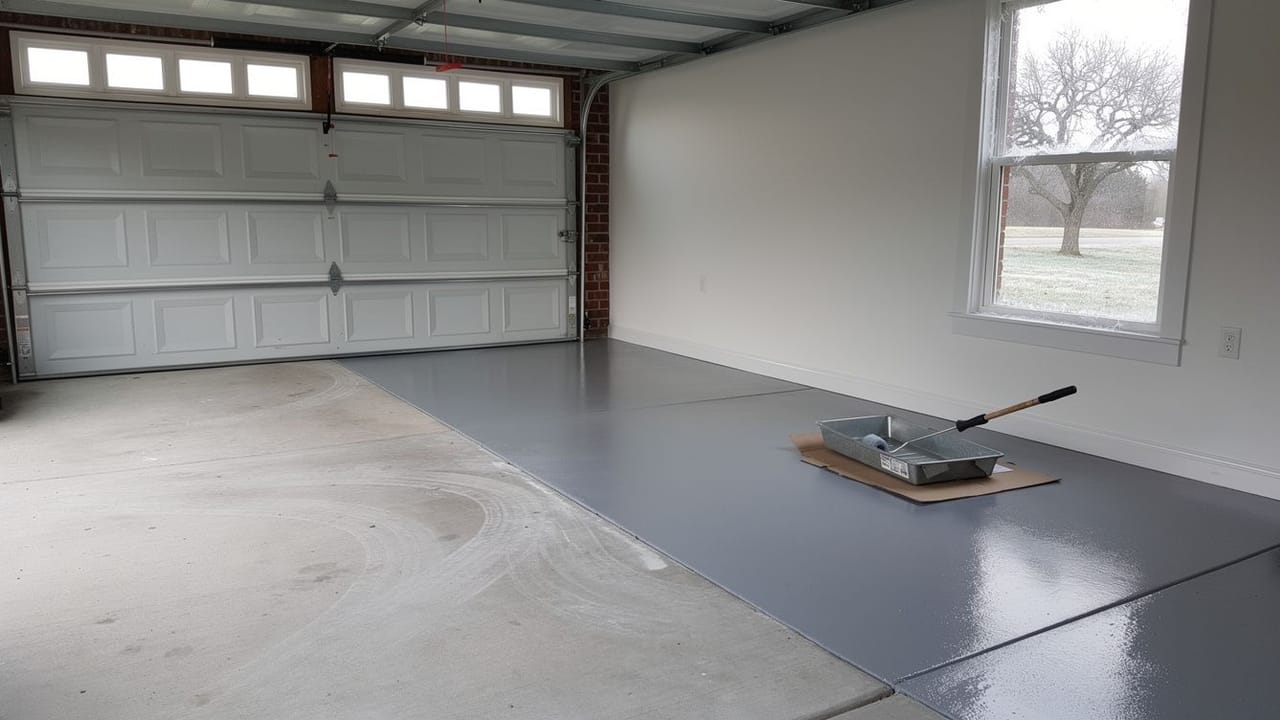
· by Michael Blair, Nashville's Garage Floor
Epoxy and polyaspartic floor coatings arrive as a resin and a hardener, and once the two are mixed they cure on a clock that temperature sets. Sika’s product page for its Sikafloor-264 epoxy gives that clock against the ambient and substrate temperature together, and the substrate is the part people miss in a Middle Tennessee fall or winter: the garage can feel mild while the concrete under it is still cold. It is the same chemistry as our epoxy floor systems, so these numbers decide when we book a cold-season job.
Why does the slab temperature matter more than the air?
A slab on grade rests on the ground and carries a lot of mass, so after a cold snap it can stay colder than the air in the garage, and one mild afternoon is no proof it has caught up. Sika’s surface prep guide treats the two as separate readings as well: the concrete has to sit at least 5°F above the dew point of the air over it, the margin it sets against water condensing on the surface before the coating goes down.
We take the slab’s temperature with a surface thermometer before anything is mixed. The lowest figure on the data sheet is the one to respect, and Sika’s tables for that epoxy do not go below 50°F. For colder slabs the company sells a separate cold-cure catalyst, Sikafloor-372, rated for substrates between 45°F and 64°F, but it is made for three of its polyurethane floors and not for its epoxies. If a garage is heated ahead of a job, the heater matters too: the EPA’s guide to indoor air quality counts unvented kerosene and gas space heaters among household sources of carbon monoxide and asks for special precautions with them.
What goes wrong when epoxy goes down too cold?
Everything slows down. At 50°F the Sikafloor-264 table gives about 24 hours to foot traffic, 3 days to light traffic and 10 days to full cure, where 68°F gets roughly 12 hours, 2 days and 7 days, and the window for a second coat moves from 8 to 24 hours out to 24 to 48 hours. That is slower, not stopped, inside the range the table covers; below 50°F it gives no numbers at all, and we do not guess at them. Cloudy or soft patches can have other causes as well. Sika lists whitening, soft spots and slow cure among the results of a wrong mix ratio or poor mixing, says any added thinner slows the cure and voids its warranty, and wants the material stored between 40°F and 90°F, so a kit left overnight in an unheated garage may be colder than its label allows before it is opened.
Damp concrete is the other cold-season risk, because a cold slab under humid air is close to its dew point. ASTM F2170, the in-place probe test for relative humidity in a slab, names debonding among the failures that excess moisture causes once a floor covering is down. Sika’s guide lists that probe test beside three other moisture tests and asks for the space to be held at its normal-use temperature and humidity for 48 hours before any of them is run, which in a cold garage takes planning. A coating that lets go has to come off by the same mechanical preparation the slab needed the first time, and our post on why garage floor coatings peel goes through the other causes.
- Measure the slab temperature as well as the air
- Find the lowest application temperature on the product’s data sheet
- Keep the slab at least 5°F above the dew point
- Expect slower cure and a longer recoat window in the cold
- Store the kit where it stays within its labeled range
Bubbles and dew in autumn
Pinholes and bubbles in a fresh floor often get blamed on the weather, but the Sika instructions we work from name causes in the application itself. The 264 page says to mix at low speed to keep air out, warns that over-rolling and late back rolling can cause bubbling, and has the thick slurry version spike-rolled within 10 minutes to release trapped air. In the cold the mixed material stays workable longer, about 50 minutes at 50°F against 25 at 68°F, which makes it tempting to go back over it. We roll each pass once and leave it alone.
Autumn’s timing problem is dew. On some fall mornings a cold slab sits close to the dew point of the air above it, and the 5°F margin in Sika’s guide exists for that case. We read the air temperature and relative humidity, find the dew point on the chart in that guide, and compare it with the slab before a kit is opened; if the margin is not there, we wait for the day to warm or move the job.
Polyaspartic and what it changes
Speed is the main thing it changes. Sika’s Sikafloor-510 LPL, a polyaspartic, is ready for foot traffic in 4 hours at 68°F and light traffic in about 8, while the epoxy above needs about 12 hours before anyone walks on it. What that page does not give is a cure table below 68°F or a stated lowest temperature, so any claim that polyaspartics cure in all weather is one we check against the product’s own sheet before we plan a winter floor around a polyaspartic top coat.
For this product, working time is longer than its reputation suggests: its pot life runs about 40 minutes at 50°F, 30 at 68°F and 20 at 86°F, though Sika warns that adding a pigment pack shortens it, and each mixed batch still has to be down before the time runs out. Preparation does not change with the resin. Sika’s guide calls for the concrete to be mechanically prepared, by shot blasting, grinding or similar methods, to take off laitance and old coatings and leave a profile, which is how we prepare every slab; we do not acid etch. If you want a date worked out for your garage this winter, ask us for a free estimate.
Sources
- Sika USA, Sikafloor-264 epoxy coating product page — Pot life, cure and recoat times at 50, 68 and 86°F by ambient and substrate temperature; mixing errors and thinners slow cure; storage between 40°F and 90°F; over-rolling causes bubbling; slurry spike-rolled within 10 minutes
- Sika USA, Surface Prep Guide — Substrate at least 5°F above the dew point; dew point chart; moisture tests including ASTM F2170 after 48 hours at normal-use conditions; mechanical preparation by shot blasting, grinding or similar
- Sika USA, Sikafloor-372 Urethane Accelerator product page — Cold-cure catalyst for Sikafloor-315, 315 N and 340, for substrates between 45°F and 64°F
- Sika USA, Sikafloor-510 LPL polyaspartic product page — Foot traffic in 4 hours and light traffic in about 8 at 68°F; cure table only at 68°F; pot life about 40, 30 and 20 minutes at 50, 68 and 86°F; pigment packs shorten working time
- U.S. EPA, The Inside Story: A Guide to Indoor Air Quality — Unvented kerosene and gas space heaters as sources of carbon monoxide; take special precautions with them
- ASTM F2170-19a, Determining Relative Humidity in Concrete Floor Slabs Using in situ Probes — Excess slab moisture after a floor covering is installed can cause debonding
FAQ
Coating a Garage Floor in Cold Weather — questions
Can a garage floor be coated in winter in Nashville?
Yes, on days when both the slab and the air are inside the range the product’s data sheet covers. Sika publishes cure times for its 264 epoxy from 50°F upward, and at that temperature foot traffic takes about twice as long as at 68°F. When the slab is colder than the lowest figure on the sheet, we wait for a warmer spell or bring the space up to temperature well ahead of the job rather than coat and hope.
Can I heat the garage to make epoxy cure?
Heat helps when the slab has time to warm as well as the air, since manufacturers give cure times for the ambient and substrate temperature together. Use a properly vented heat source, because the EPA lists unvented kerosene and gas space heaters among indoor sources of carbon monoxide. Whatever the heat, the concrete has to be dry and stay at least 5°F above the dew point when it is coated.
How soon can I park on a floor coated in cold weather?
Walking comes first, then light traffic, then full cure. Sika gives its 264 epoxy about 12 hours, 2 days and 7 days for those three at 68°F, and about 24 hours, 3 days and 10 days at 50°F. Its page has no separate figure for cars, so we count from full cure at the temperature the garage actually held during the cure, which in a cold month means waiting longer.
What temperature do you need to epoxy a garage floor?
At least the lowest temperature on that product’s data sheet, measured at the slab as well as in the air. Sika’s tables for its 264 epoxy start at 50°F and give nothing below it, so we treat that as the limit for that product. The concrete also has to sit at least 5°F above the dew point.