
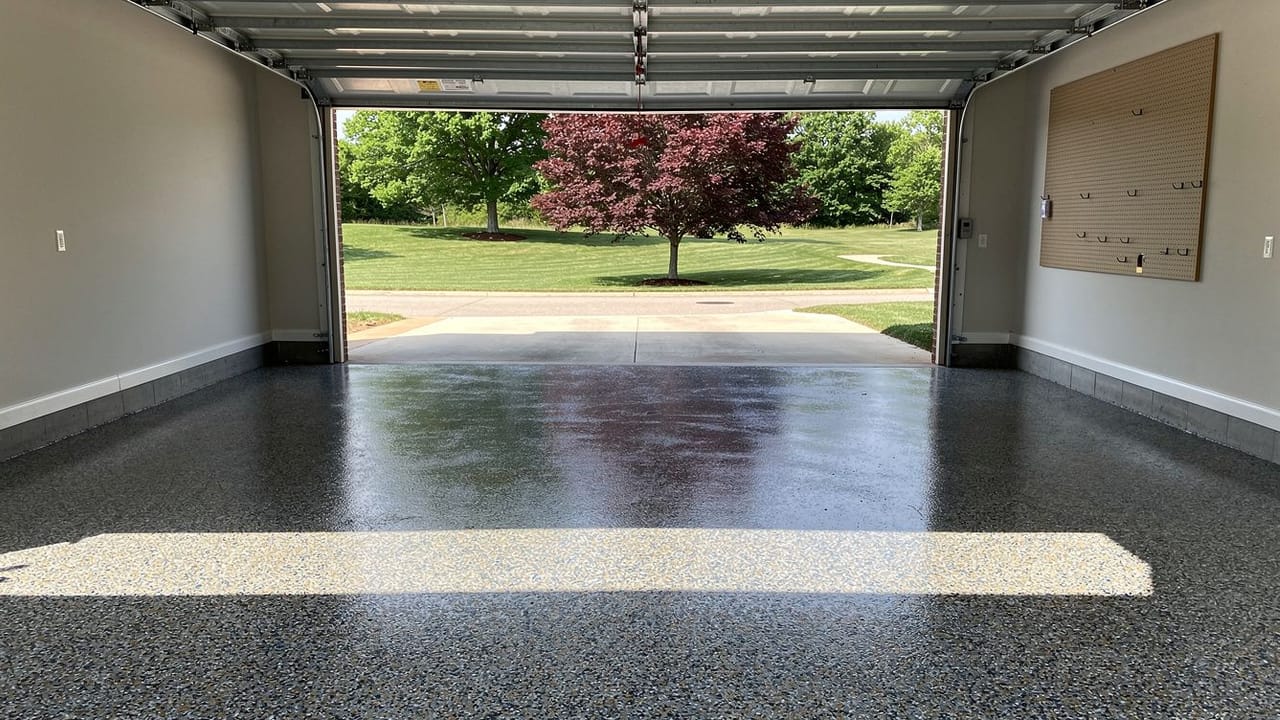
· by Michael Blair, Nashville's Garage Floor
Both are legitimate systems, and a common build uses the two together, epoxy underneath and polyaspartic on top. We install both: epoxy floors with a top coat, and polyaspartic coatings where the floor takes sun or has to be back in use quickly. The differences that matter in practice are cure speed, sunlight and how forgiving each one is to apply.
What does epoxy do in a garage floor?
Epoxy is the layer that builds thickness. Sika’s Sikafloor-264 product page lists its pigmented epoxy at 12 to 15 mils wet as a wear coat, and at 60 to 120 mils when it is mixed with filler and poured as a self-leveling slurry. The same page gives tensile adhesion above 400 psi with the concrete failing first. That bond depends on the slab being mechanically profiled, which Sika’s surface prep guide says is done by shot blasting, grinding or similar methods.
What the epoxy page does not claim is UV resistance. Sika files its polyaspartic under urethane UV-resistant coatings, and its DecoDur flake floor systems seal a clear epoxy binder under a transparent or UV-stable topcoat. We do the same wherever afternoon sun reaches the slab through an open door, so the epoxy sits under the flake and out of the light.
Polyaspartic and polyurea
The difference you notice first is time. At 68°F, the Sikafloor-510 LPL page gives its polyaspartic foot traffic at 4 hours, light traffic at about 8 hours and full cure at about 5 days; the epoxy above needs about 12 hours, 2 days and 7 days at the same temperature. Sika rates the 510 for excellent UV and chemical resistance, and in the ASTM D4060 abrasion test it loses about 50 mg against 90 mg for the epoxy. That is why it is our usual top coat. Polyurea is a related resin with its own place in the floor, which our post on polyurea or polyaspartic covers.
How forgiving it is to put down depends on the product. Sika’s pair runs against the usual story: the 510 gives about 30 minutes of pot life at 68°F and the epoxy about 25, and both shorten as the material warms, to 20 and 15 minutes at 86°F. Sika also warns that its pigment packs can shorten the 510’s working time. Either one can be rolled by a careful homeowner, but neither waits once it is mixed, and the data sheet for the exact product is the one to read. The cure stages after that are explained in our post on when you can park on a new coating.
- Epoxy base for build and grip on the ground slab
- Polyaspartic top coat for UV resistance and a faster return to use
- Flake or quartz broadcast into the base for texture and color
- Cure times read from the data sheet at the garage’s temperature
Why use epoxy and polyaspartic together?
An epoxy base gives build and bond; a polyaspartic top gives abrasion resistance, chemical resistance and UV stability. Sika’s Flake FX system shows the pattern: a primed slab, vinyl chip broadcast into a clear epoxy binder, and a UV-stable coat over it. Our full-flake and quartz systems are layered the same way.
A single-product floor is possible. The same Sika page lists a Flake FS system built around a high-solids polyaspartic for a fast return to service, and an epoxy-only floor is still a fair choice in a garage that never sees direct sun. Each gives something up, either the epoxy’s build or a coat over it that takes the light.
Middle Tennessee considerations
A garage door left open on a summer afternoon puts direct sun on the first few feet of the floor, which is also the part a car crosses every day. Heat matters on the day of the install too: at 86°F those pot lives drop to 15 and 20 minutes, so on a summer job we mix less at a time.
Slab moisture can undo either product. ASTM’s F2170 test method for relative humidity in concrete slabs notes that excess moisture after a floor covering goes down can cause debonding and deterioration of coatings, and that manufacturers generally require moisture testing before installation. We take those readings before we specify anything, and if you would like that done on your floor, ask us for a free estimate.
Sources
- Sika USA, Sikafloor-264 (pigmented epoxy) product page — Wear-coat and slurry thickness, tensile adhesion over 400 psi, pot life and cure times by temperature, abrasion loss 90 mg (ASTM D4060)
- Sika USA, Sikafloor-510 LPL (polyaspartic) product page — Foot, light-traffic and full-cure times at 68°F, pot life by temperature, pigment shortening working time, excellent UV and chemical resistance, abrasion loss about 50 mg
- Sika USA, Sikafloor DecoDur decorative floor systems — Flake FX: clear epoxy binder with vinyl chip under a transparent or UV-stable topcoat; Flake FS: fast-cure polyaspartic flake system
- Sika USA, Surface Prep Guide — Mechanical profiling by shot blasting, grinding or similar; shot blasting as the industry standard; diamond grinding
- ASTM F2170-19a, Determining Relative Humidity in Concrete Floor Slabs Using in situ Probes — Excess slab moisture can cause debonding and deterioration of coatings; manufacturers generally require moisture testing before installation
FAQ
Epoxy or Polyaspartic for a Garage Floor — questions
Is polyaspartic better than epoxy?
For the top coat, usually. Sika’s data puts its polyaspartic on foot traffic in 4 hours against about 12 for its epoxy at 68°F, rates it for excellent UV resistance and shows less abrasion loss. Epoxy still does its job underneath, where it builds thickness and bonds to the ground slab. A common system uses both rather than choosing between them.
How long before I can park on a new coating?
It depends on the product and the temperature, so go by the data sheet for what was actually applied. At 68°F Sika lists full cure at about 5 days for its polyaspartic and about 7 for its epoxy, and its epoxy takes about 10 days at 50°F. Neither of those pages gives a separate figure for cars, so the drive-on time to trust is the one the maker of your product publishes.
Can I apply polyaspartic myself?
It is possible, and it is unforgiving. Once mixed it has to be down within its pot life, about 30 minutes at 68°F for Sika’s 510 and shorter in heat or with pigment added. The slab also has to be mechanically profiled first; Sika’s surface prep guide calls shot blasting the industry standard and describes diamond grinding as well. The preparation is the hard part of any garage coating, and polyaspartic adds a timing difficulty on top.
What are the disadvantages of epoxy on a garage floor?
Sunlight and speed are the main ones. Sika’s epoxy page claims no UV resistance, so where sun reaches the slab, the epoxy sits under the flake with a UV-stable coat over it. It cures slower too, about 12 hours to foot traffic and 7 days to full cure at 68°F, and it wears faster in the abrasion test.