
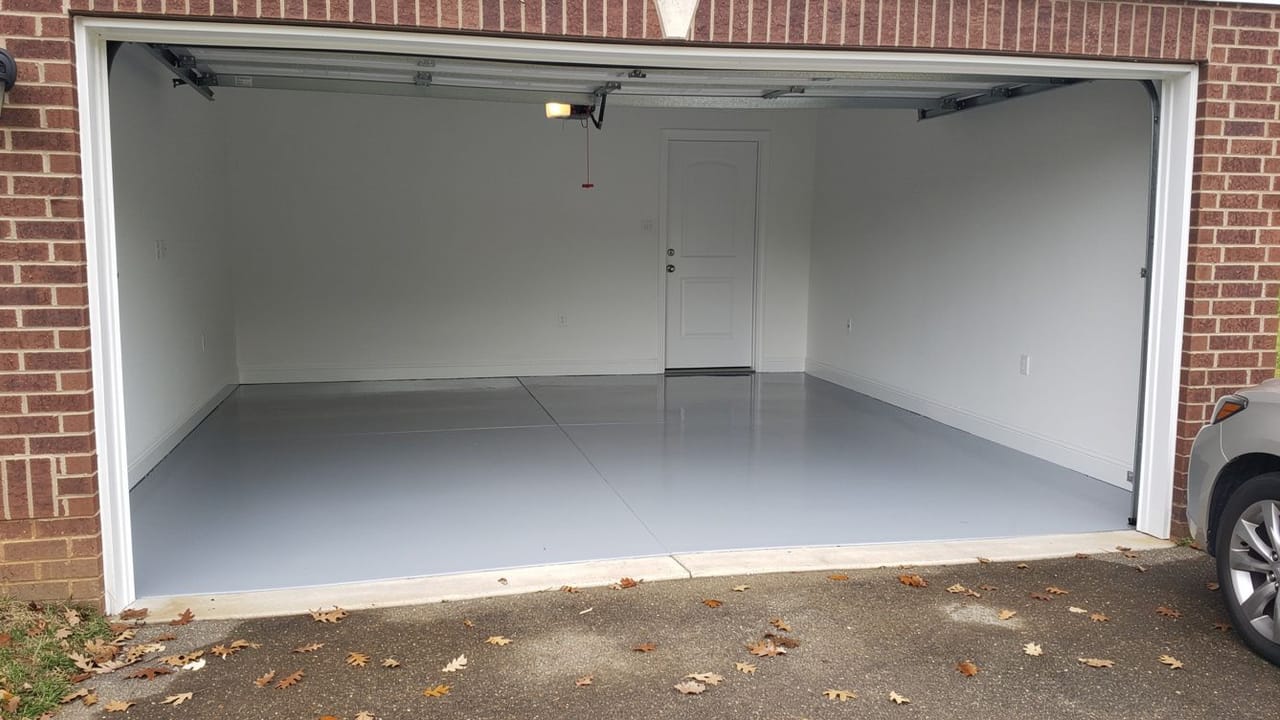
· by Michael Blair, Nashville's Garage Floor
A new garage floor coating passes three points after it goes down, and the manufacturer’s data sheet gives a time for each: when it can take foot traffic, when it can take light traffic, and when it reaches full cure. Only the last one matters for a car, and it arrives days after the floor looks finished.
The three numbers
Those times belong to one product at one temperature. Sika’s product page for Sikafloor-264, a pigmented epoxy it lists for garages, gives about 12 hours to foot traffic, about 2 days to light traffic and about 7 days to full cure at 68°F. Its polyaspartic, Sikafloor-510 LPL, takes foot traffic in 4 hours and light traffic in about 8, yet Sika still lists about 5 days to full cure. Neither table says when a car can come in, so we treat the full-cure figure as the drive-on date, whether the floor is one of our epoxy systems or a polyaspartic coating.
Temperature moves every one of those figures, and Sika heads its table with the ambient and substrate temperature, so a cold slab counts against you even when the air feels mild. At 50°F the same epoxy needs about 24 hours, 3 days and 10 days; at 86°F it is down to about 8 hours, 36 hours and 4 days, while the time to spread each mixed batch shrinks from about 25 minutes to about 15. A floor coated late in the fall in an unheated garage runs on the slow end of that table, which is why our post on coating in cold weather goes into the slab itself.
What happens if you drive on a new coating early?
Driving on it early loads a film that has not yet reached its data-sheet figures, which describe the finished coating. Sika lists a Shore D hardness of 80 to 85 for Sikafloor-264 and a bond to concrete above 400 psi, both measured at 73°F, and a floor that feels hard on day two has not finished the reaction that gets it there. A car puts its whole weight on four small patches, and turning the wheel while parked twists the coating under one of them.
We do not test that on a customer’s floor. The car stays out until the full-cure time for that product, at the temperature the garage actually ran, has passed. If a coating you already have is lifting or coming away in sheets, our post on why garage floor coatings peel walks through the usual causes.
- Before the foot traffic time: nothing on the floor at all
- After foot traffic: walking only, no dragging, no furniture
- After the light traffic time: shelving and stored items, on protective pads
- After full cure: vehicles, and turning the wheel while parked
Does a new garage floor coating smell?
How much a coating smells depends on what is in it. Sika sells Sikafloor-264 as solvent-free and low odor, and other products carry solvents. The EPA’s page on volatile organic compounds counts paints and solvents among indoor sources, warns that high levels can linger well after the work is done, and says to increase ventilation, meet or exceed the label precautions and keep the products away from children and pets. Its guide to improving indoor air quality names painting among the short jobs that can spike pollutant levels and notes that a fan exhausting outdoors pulls contaminants straight out of the room. On our jobs that means the big door partly open, the door into the house shut, and nobody sanding or sweeping in there while the surface is wet.
Moisture is the other risk in the first hours. Sika’s surface preparation guide calls the dew point one of the most critical conditions for a resin coating, ties moisture on the surface to poor adhesion and delamination, and wants the slab at least 5°F above the dew point. We check the humidity and the forecast before we mix, and we will move a job rather than coat into a muggy afternoon with storms coming.
The first week, and after
Moving things back in is where floors get scratched. Drag nothing, put felt or rubber under shelving feet, and keep sharp metal edges off the surface. If the shelving is going back on the walls rather than the floor, our post on garage storage that holds up covers fixing it into studs and joists and keeping it clear of the water heater. Until the full-cure date the film is still gaining hardness, and even a cured coating is tough rather than indestructible.
Chemical resistance varies from product to product. Sika describes its 510 LPL as resisting a wide range of acids, alkalis, salts and solvents, yet its chemical resistance entry just says to consult its technical services team. Wipe up gasoline or brake fluid when you see it, ask your installer for the product name and its cleaning instructions, and treat the drive-on date as the earliest day the car comes in. If you want that schedule worked out for your floor and the time of year, ask us for a free estimate.
Sources
- Sika USA, Sikafloor-264 epoxy coating product page — Foot traffic, light traffic and full cure times at 50, 68 and 86°F; pot life by temperature; hardness and adhesion figures; solvent-free, low odor; mixing errors cause slow cure and soft spots; thinners slow cure
- Sika USA, Sikafloor-510 LPL polyaspartic product page — Foot traffic in 4 hours, light traffic about 8 hours, full cure about 5 days at 68°F; resists a wide range of acids, alkalis, salts and solvents; chemical resistance entry refers to technical services
- Sika USA, Surface Prep Guide — Dew point as a critical condition; moisture causes poor adhesion and delamination; substrate at least 5°F above the dew point
- U.S. EPA, Volatile Organic Compounds’ Impact on Indoor Air Quality — Paints and solvents as VOC sources; levels persist after the activity; increase ventilation, follow label precautions, keep from children and pets
- U.S. EPA, Improving Indoor Air Quality — Painting as a short-term activity that raises pollutant levels; fans that exhaust outdoors remove contaminants from the room
FAQ
When You Can Park on a New Garage Floor Coating — questions
How long after epoxy can I park my car in the garage?
It depends on the product and on the temperature of the slab. Sika lists full cure for its Sikafloor-264 epoxy at about 7 days at 68°F and about 10 days at 50°F, and we treat full cure as the earliest day to drive on a floor. Polyaspartic coatings take foot traffic much sooner, but Sika still gives about 5 days to full cure for its 510 LPL. Use the figure for the product actually applied, at the temperature your garage actually held.
What happens if I drive on a garage floor coating too soon?
You put the full weight of the car, and the twist of a turning wheel, on a coating that has not yet reached the hardness and bond its data sheet describes. Fixing a damaged spot means more work on a floor you just paid for, so we keep cars off until the full-cure time has passed.
Why is my new garage floor still tacky?
Cold is the usual reason. Sika’s table for its 264 epoxy roughly doubles the foot traffic time between 68°F and 50°F. Sika also warns that a wrong mix ratio or poor mixing can cause slow cure and soft spots, and that thinning the product slows its cure. If the floor is still soft well past the data sheet time for the temperature in your garage, have the installer come back and look at it.
How do you protect a new epoxy garage floor?
Keep everything off it until each cure stage passes, then move things back without dragging them. Put felt or rubber under shelving feet, keep sharp metal edges off the surface, and wipe up gasoline or brake fluid when you see it. Ask the installer for the product name and its cleaning instructions.