
· by Michael Blair, Nashville's Garage Floor
Coatings are not the only option, and on a slab with moisture or condition problems they are sometimes the wrong one: EPA’s moisture control guidance says flooring and coatings will fail if they go down before the surface is dry enough. Tiles and mats sit on the concrete rather than bonding to it, which changes the calculation, though the slab’s moisture still has a say whichever you choose.
Interlocking tiles
Thick, rigid plastic tiles that snap together and float on the slab. Swisstrax’s garage tile FAQ describes a peg-and-loop connection with no adhesive, laid right over the existing floor in a few hours, and says the system comes apart when you need to replace a damaged tile.
Preparation is light, though not quite nothing. The maker’s installation guide asks for a swept or vacuumed floor, then wants the tiles kept at 72°F or warmer for 24 hours before they go down, so in an unheated garage in winter the boxes spend a day in the house first.
Their perforations are there so spills and wash water drain through to the concrete. The FAQ says nothing about vapor coming up from a damp slab, and we would not lean on tiles to handle it: a slab with a real moisture problem gets tested, and the source found, before anything goes on top.
Roll-out mats
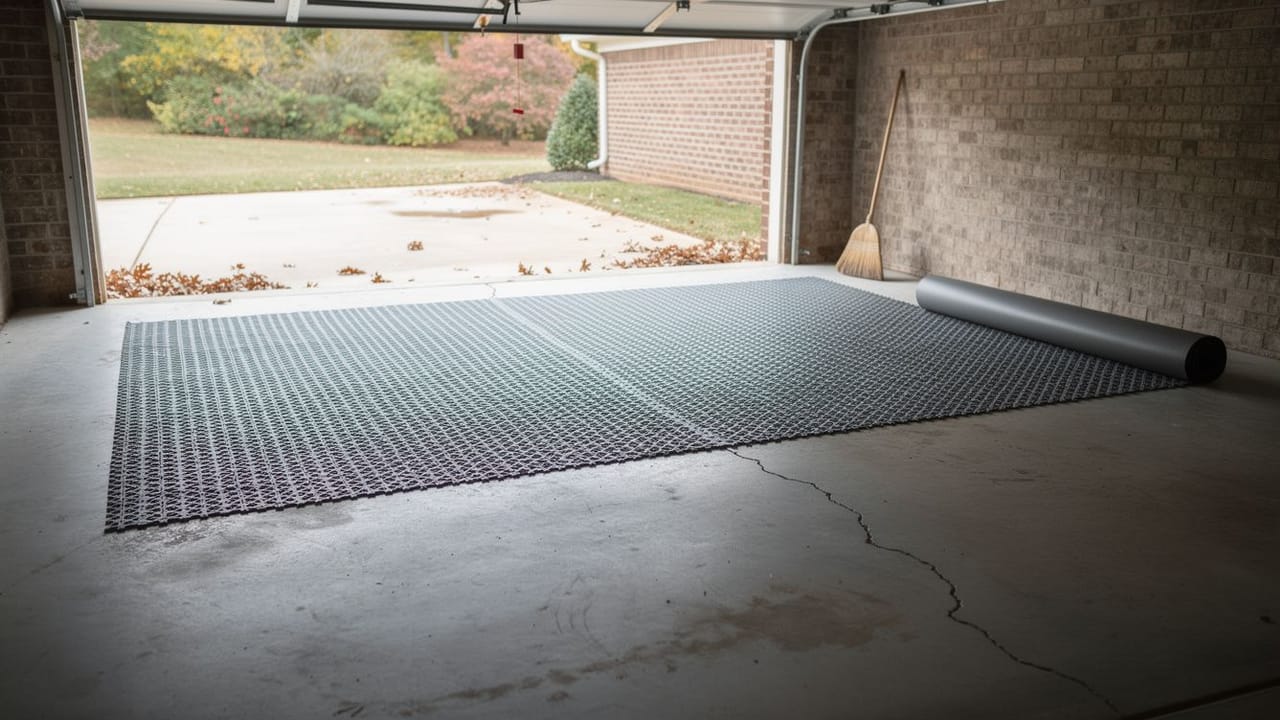
Vinyl sheet rolled over the floor, usually in a garage-width run. Nothing is glued down or ground, so it comes up as easily as it went down.
The catch is underneath. Vinyl holds vapor back, and EPA’s guidance lists impermeable flooring on a concrete slab that is releasing too much water vapor among the causes of moisture problems. On a dry slab a mat is fine; on a damp one, the moisture question applies to it just as it does to a coating.
- Tiles: a swept floor, a day indoors to warm up, and a damaged tile swaps out
- Mats: quick to lay and to lift, and they hold vapor against the slab
- Coating: a seamless surface, on a slab that is dry and properly prepared first
- Polished concrete: the ground slab itself becomes the finish
When are tiles a better choice than a coating?
Tiles suit a dry slab that is cracked, stained or patched, and a household that wants the floor finished over a weekend. Swisstrax calls tiles one of the best ways to cover cracked concrete, which is a maker speaking for its own product, though a floor that never bonds to the slab is not much bothered by how the surface looks. If you would rather coat it, our post on fixing cracks before coating covers the repair.
Where the slab’s history is uncertain, measure before choosing. EPA’s guidance calls for a water vapor emission test on a concrete slab before flooring is installed, naming ASTM F1869, the calcium chloride test, and ASTM F2170, and that result settles more of the decision than taste does.
Coatings suit a sound, dry slab. We grind and repair the concrete first, which is our concrete prep work, and on a slab like that an epoxy floor gives the seamless easy-clean surface most people picture. For a finish with no coating on it at all, our post on polished concrete and grind and seal sets out the choices.
What are the downsides of garage floor tiles?
Water and grit pass through perforated tiles by design and end up on the concrete underneath. Swisstrax’s home page says the quarter-inch channels under its tiles let debris and liquids be washed out when required, so the slab below still wants an occasional flush, and on a slab that already struggles with moisture that is more water we would rather keep off it.
And they read as tiles rather than as a finished floor, which some people mind and some do not. If you cannot tell which way your slab leans, ask us for a free estimate and we will look at the concrete before we talk about what goes on it.
Sources
- U.S. EPA, Moisture Control Guidance for Building Design, Construction and Maintenance (EPA 402-F-13053, 2013) — Flooring and coatings fail if applied before surfaces are dry enough; impermeable flooring on a slab releasing too much water vapor; vapor emission test (ASTM F1869 or F2170) before installing flooring
- Swisstrax, Garage Floor Tiles FAQ — Peg-and-loop connection with no adhesive; laid over the existing floor in a few hours; replacing a damaged tile; perforations let liquids flow through; tiles to cover cracked concrete
- Swisstrax, How to Install Swisstrax Tile Systems — Sweep or vacuum the floor; condition the tiles at 72°F or higher for 24 hours before installation
- Swisstrax, home page — Quarter-inch channels let debris and liquids be washed out from under the tiles
FAQ
Tiles and Mats Instead of a Coating — questions
Are garage floor tiles better than epoxy?
Different rather than better. Interlocking tiles need little preparation beyond a clean floor, go down in a few hours once they have warmed to room temperature, and a damaged tile can be swapped out. A coating gives a seamless, easier-to-clean surface and needs a dry, properly prepared slab. Neither one fixes a damp slab, so the condition of the concrete, and a moisture test where there is doubt, usually decides.
Do garage tiles work on a cracked floor?
Usually. Tiles float over the slab rather than bonding to it, so they cover surface cracks and stains, and at least one tile maker sells them on exactly that. A crack that is still moving, or has left one side higher than the other, is a slab problem to look at before anything goes over it. Before we coat a floor we repair its cracks, because a coating bonds directly to the concrete.
Will a roll-out mat trap moisture?
It can. Vinyl holds back vapor rising through the slab, and the EPA lists impermeable flooring on a slab releasing too much water vapor among the causes of moisture problems. On a dry slab that is not a concern. Older slabs may have no vapor barrier under them, and a moisture test shows what the slab is doing before you choose a mat, tiles or a coating.
How do you install garage floor tiles?
Sweep or vacuum the slab, then let the tiles sit at 72°F or warmer for 24 hours before laying them, which in a cold garage means a day in the house. They snap together with pegs and loops, with no adhesive, and float on the existing floor, so the maker says a garage takes a few hours.