
· by Michael Blair, Nashville's Garage Floor
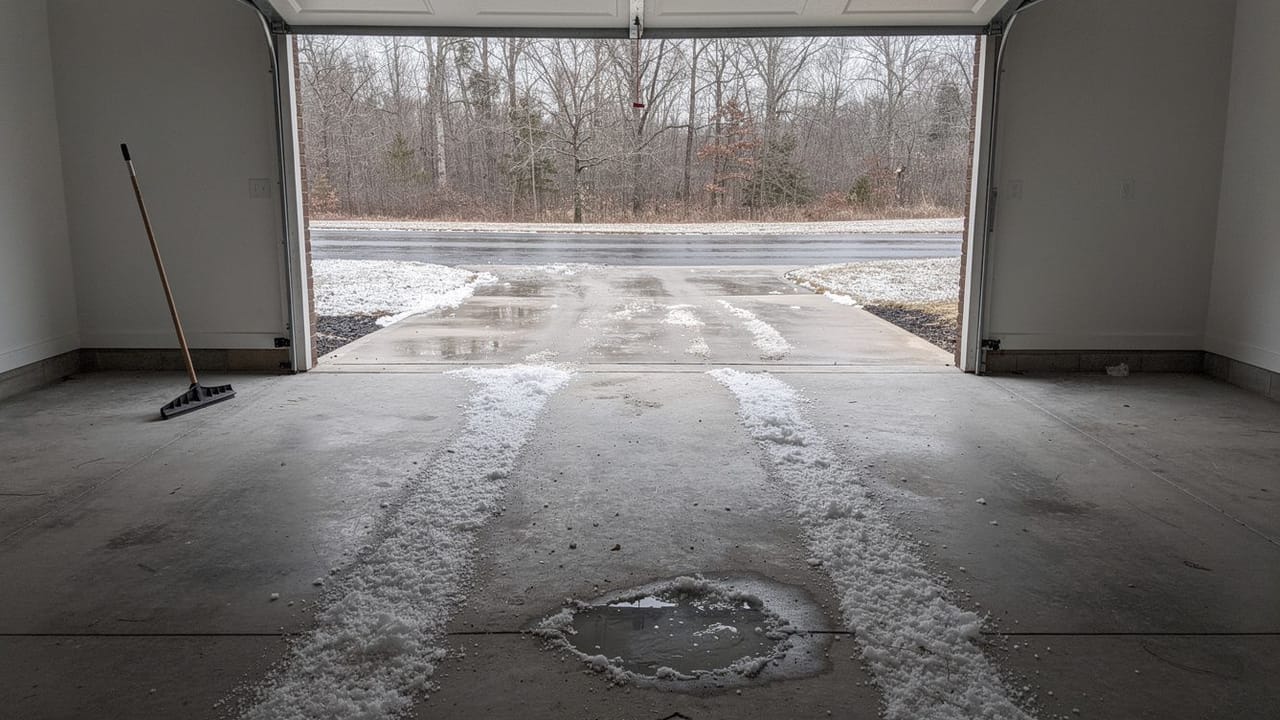
When snow is coming, Metro’s transportation department usually handles up to two inches of it by salting, or with combinations of salt and calcium chloride, according to Metro Nashville’s snow removal page. Every car on those roads carries some of it home. It drips off the undercarriage onto the garage floor, dries into a white crust, and gets wet again the next time the car comes in. Winter after winter, that wears at the surface of bare concrete, and at any coating that wasn’t built to take it. The damage is slow, and it starts where the tires sit.
How salt damages concrete
Salt doesn’t dissolve concrete. The National Ready Mixed Concrete Association’s guide to scaling concrete surfaces explains the damage as freeze-thaw: water in saturated concrete expands as it turns to ice, and deicing chemicals make that worse by keeping the surface wetter and adding to the number of freezing and thawing cycles. The result is scaling, the surface flaking or peeling in patches, and by the time it is moderate the aggregate shows through. The same guide counts rock salt and calcium chloride as acceptable deicers for concrete, but warns that magnesium-based salts, used on roads ahead of snow, attack the surface and get tracked onto slabs by cars.
The chlorides also work their way down. The Bureau of Reclamation’s Guide to Concrete Repair names deicing salts as a common source of chloride, which breaks down the protective layer around embedded steel; the rust takes up more room than the steel did, and the concrete around it cracks. That needs steel in the slab to act on, and it shows up as cracking rather than flaking.
What it does to coatings
A two-part coating over properly prepared concrete is a different surface. Sika describes its Sikafloor-264 epoxy as impermeable and seamless, with garages among its listed uses, and says its Sikafloor-510 polyaspartic resists a very wide range of chemicals, salts included. On a floor like that the brine sits on top and mops up. When a coated floor starts coming apart in winter, we look first at the edges, the threshold and any chip, since those are the places brine can get under the film to the concrete.
What was left on the concrete before the coating went down matters just as much. ASTM D4259, the standard practice for abrading concrete before coating, is written to create a surface profile and to remove foreign materials and weak surface laitance. A salted slab needs the salt dealt with too: the concrete coating specification in the Reclamation guide calls for a soluble-salt test on the prepared surface wherever salts are suspected. A one-part floor paint is a thin film by comparison, and we don’t count on one to keep brine off the concrete through a winter of tire traffic.
- Bare concrete: flaking at the tire tracks first, then spreading
- Floor paint: worn spots at the tracks, with brine reaching the concrete
- Epoxy or polyaspartic over ground concrete: brine stays on top and wipes up
- Any coating with chips or open edges: that is where failure starts
How do you keep road salt off a garage floor in winter?
The simplest measure is getting the brine off before it dries and before it freezes. NRMCA advises hosing off the salt that cars leave on driveways and garage slabs when conditions permit, and notes that poor drainage, which lets salt solutions sit on the surface, makes scaling more severe. Push it to the drain or out the door with a squeegee after a wet drive, or rinse on a mild day. If water pools in your garage instead of leaving it, our post on water on the garage floor traces where it comes from.
A containment mat under each car catches the drips and can be emptied outside, and on a bare floor that isn’t going to be coated it’s what we’d put down. Don’t let the crust build up all winter and wash it out in spring; by then it has had months on the concrete. Rinsing the underside of the car on a day above freezing means less of it rides into the garage at all.
What protects a garage floor from salt for good?
On bare concrete, a penetrating sealer is the first step. NRMCA recommends a breathable silane or siloxane sealer made for slabs, applied when the concrete is reasonably dry, and calls late summer after a few dry days the ideal time. The Reclamation guide describes penetrating sealers as a cost-effective protection that screens out chlorides and improves durability against freezing and thawing, applied as part of a maintenance program. A sealer prevents; it won’t repair a floor that is already flaking. The lasting answer is a full coating system, with the concrete diamond-ground rather than etched, cracks and scaled patches repaired, and an epoxy base under a topcoat, and it turns the winter drips into a job for a mop.
If the floor is already scaling, the loose material comes off first. NRMCA lists polymer-modified cementitious repair mortar among the thin bonded resurfacing options for light to moderate scaling, and warns that a repair is only as strong as the surface it is bonded to. A coating works the same way: laid over loose scale, it is bonded to concrete that is already coming apart, and it lets go where that concrete does. If your floor is flaking at the tracks, ask us for a free estimate and we’ll look at the scaling before we price anything.
Sources
- Metro Nashville Department of Transportation and Multimodal Infrastructure, Snow Removal — Up to two inches of snow usually handled by salting, or salt and calcium chloride, on Metro priority routes
- National Ready Mixed Concrete Association, CIP 2 Scaling Concrete Surfaces — Scaling defined; deicers raise saturation and freeze-thaw cycles; magnesium salts tracked by cars; hose off salt on garage slabs; poor drainage; silane or siloxane sealer; polymer-modified repair mortar; repair only as strong as its base
- U.S. Bureau of Reclamation, Guide to Concrete Repair, Second Edition (2015) — Deicing salts as a chloride source; chlorides and corrosion of embedded steel; penetrating sealers as chloride screens; soluble-salt test before coating concrete
- Sika USA, Sikafloor-264 product page — Two-part epoxy described as impermeable and seamless; garages among listed uses
- Sika USA, Sikafloor-510 LPL product page — Polyaspartic described as impermeable and resisting a wide range of chemicals including salts
- ASTM D4259-24, Standard Practice for Preparation of Concrete by Abrasion Prior to Coating Application — Abrasion creates a surface profile and removes foreign materials and weak surface laitance before coating
FAQ
What Road Brine Does to a Garage Floor — questions
Does road salt damage a garage floor?
Yes, on bare concrete. Deicing salt keeps the surface wetter and adds freeze-thaw cycles, which flakes the surface, starting where the car drips. Its chlorides can also reach any steel in the slab and rust it. Hosing the salt off promptly and sealing or coating the floor reduces the damage.
Will epoxy protect my garage floor from salt?
A two-part epoxy or polyaspartic coating over properly prepared concrete is impermeable, so brine stays on top and wipes up. Failures start at chips, open edges and the threshold, or where salt and loose scale were left on the concrete before it was coated. Repair any scaling and clean the salt out first.
How do I clean salt off a garage floor?
Hose or squeegee it toward the drain or out the door while it is still wet, on a day above freezing, rather than letting the crust build up over the winter. A containment mat under each car catches the drips before they reach the floor.
How do you repair a salt-damaged garage floor?
Take the loose, flaking concrete off first, because a repair is only as strong as what it bonds to. NRMCA lists thin bonded resurfacing with polymer-modified cementitious mortar for light to moderate scaling. A sealer will not undo damage already done, and a coating laid over loose scale lets go along with it.