
· by Michael Blair, Nashville's Garage Floor
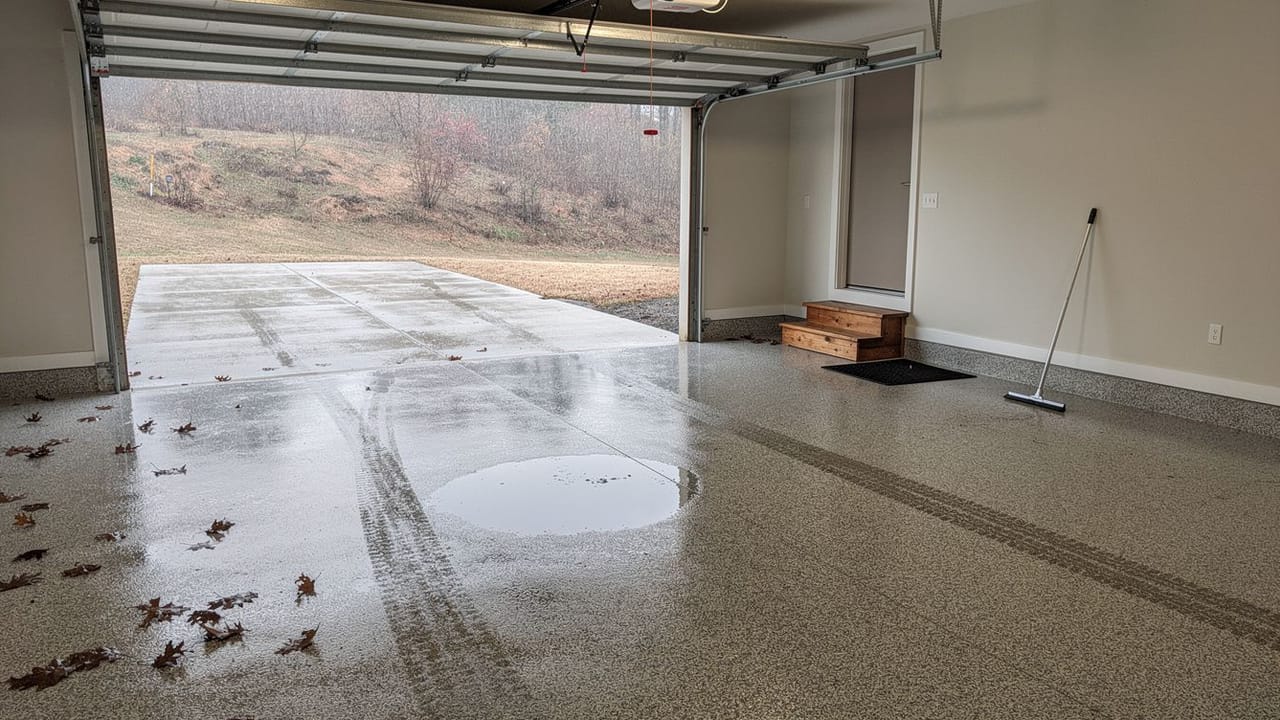
The question comes up in fall and winter, when cars roll in wet from the rain, the dog tracks in soggy leaves, and the step down from the kitchen door is where everyone crosses. A coating changes the surface underfoot. Sika’s product page for its Sikafloor-264 floor epoxy lists a glossy finish among the selling points and says a slip-resistant surface is possible, which tells you grip is something chosen at installation, not something every coated floor has. How a given floor behaves wet depends almost entirely on those choices.
Why a wet coating loses grip
Water on a walking surface is a slip hazard whatever the floor is made of. OSHA’s walking-working surfaces rule was written to address slip, trip and fall hazards at work, and the general requirements in 29 CFR 1910.22 have employers keep floors clean and, as far as feasible, dry, and free of leaks and spills. A home garage is not a workplace, but the principle carries over. Our own rule of thumb sits on top of it: the smoother and glossier the finish, the less there is for a shoe sole or a tire tread to bite on once a film of water lies over it. Dry, the same floor is usually fine underfoot.
Oil makes it worse. Sika describes that same epoxy as impermeable, so a drip of motor oil or power steering fluid does not soak into the coating. It stays on top as a slick patch until somebody wipes it up. That is the other side of a floor that does not absorb stains: whatever lands on it stays exactly where it fell.
How does an installer make a coated floor less slippery?
The flake broadcast is the main lever, and it is the heart of our full-flake systems. Sika’s application steps for its Sikafloor-510 LPL polyaspartic lay out the sequence: flakes are broadcast into the wet coat until it will take no more, the excess is swept and vacuumed off once the coat can bear foot traffic, and a clear finish coat goes on at 10 to 15 mils without ponding. The edges of those chips are where the texture comes from. We keep the clear coat to the thickness on the data sheet instead of piling on extra coats for shine, because every added coat smooths over more of those edges.
For more grip, a fine grit goes into the topcoat. Sika’s 264 page lists a slip-resistant surface as an option and gives its own instructions for applying the coat over a rough or broadcast quartz surface. Grit leaves the floor with a light sandpaper feel. The trade-off we explain is cleaning: more texture holds more fine dirt and makes the floor harder to mop, so we usually put a moderate amount across the floor and more on the walk paths and the step down from the house.
- Full flake broadcast, with a clear coat kept to the data-sheet thickness
- Grit additive in the topcoat, heavier where people walk
- Extra texture on steps, ramps and the apron edge
- Solid-color systems with no flake, which have the least texture of all and need grit the most
Can a slick garage floor coating be fixed?
A coating in good condition can take a new textured topcoat. Every product has a recoat window on its data sheet, and Sika gives 8 to 24 hours at 68°F for the 264 epoxy, so a floor that has been down for years is long past it. We abrade the old topcoat with a floor machine and a sanding screen, clean it thoroughly and roll a fresh coat with grit mixed in over the scuffed surface. That only works when the coating underneath is sound. If it is lifting at the door or around the drain, we repair that first, and our post on why garage floor coatings peel covers the usual causes.
Short of recoating, mats do a lot of the work. The OSHA rule calls for dry standing places, such as platforms and mats, where a floor is kept wet by the work done on it, and the same idea serves a garage: rubber-backed mats at the house door and under the front of each car catch water before it spreads. Adhesive anti-slip treads on the garage steps help where people step down in socks or slippers. A floor squeegee kept by the door pushes a puddle out to the apron quickly.
Living with it through the wet months
Fall is when a coated floor gets tested. A car that comes in after a rainy drive drips a puddle under each wheel well, and leaves stick to the tires and ride in with them. A wet leaf on a smooth coating is slick, and blowing the apron and the driveway edge clear during leaf drop cuts down how many make it inside. If the water is coming in under the door or up through the slab instead of off the car, that is a separate problem, and our post on where garage floor water comes from walks through it.
The floor itself asks for very little. Sweep it, mop it with the cleaner the coating manufacturer names, and rinse well so no residue dries on the surface. Check that same care sheet before using a strong degreaser on the topcoat. The installer should be able to hand you the sheet, and if your floor is already slick and you want to know whether it can take a textured coat, ask us for a free estimate.
Sources
- OSHA, 29 CFR 1910.22 Walking-working surfaces: general requirements — Floors kept clean and, as far as feasible, dry; surfaces free of leaks and spills; dry standing places such as platforms and mats where floors are wet (a workplace rule, used as a general principle)
- OSHA, Walking-Working Surfaces and Personal Fall Protection Systems final rule — The rule addresses slip, trip and fall hazards on walking-working surfaces
- Sika USA, Sikafloor-264 product page — Glossy finish; slip-resistant surface possible; impermeable; application over a rough or broadcast quartz surface; recoat window of 8 to 24 hours at 68°F
- Sika USA, Sikafloor-510 LPL product page — Flake broadcast to rejection, excess swept and vacuumed after cure, clear finish coat at 10 to 15 mils without ponding
FAQ
Is a Coated Garage Floor Slippery When Wet — questions
Are epoxy garage floors slippery?
They can be when wet, particularly a smooth, glossy epoxy with no flake or grit, and a smooth polyaspartic is no different. A flake broadcast and an anti-slip additive in the topcoat give a coated floor better grip when it is wet.
Can anti-slip be added to an existing garage floor coating?
Usually, if the coating is well bonded. The surface is abraded, cleaned and recoated with a topcoat that has grit mixed in. If the old coating is peeling anywhere, that has to be repaired first or the new layer will fail with it.
Does an anti-slip additive make the floor harder to clean?
Somewhat. The texture holds fine dirt, so a heavily gritted floor needs a mop or soft brush rather than a quick wipe. We usually put more texture where people walk and less where cars park, balancing grip against cleaning.
Why is my epoxy floor rough?
If the floor was built with flake or grit, the roughness is deliberate. The edges of the chips under a clear coat kept to its data-sheet thickness give it texture, and a fine grit in the topcoat leaves a light sandpaper feel that helps shoes and tires grip when wet. The trade-off is that more texture holds more fine dirt.